Tiers name what a vendor publishes, not a verdict on any product's purity or quality.
Lab-verifiable COAs: certificates that open on the testing lab's own site (the seal's ring shows what share of them do).
Third-party COAs: certificates attributed to a third-party lab, which may be hosted only on the vendor's site.
Tiers follow the Vendor Score (90+ and 80–89), which is 87% COA evidence; the numeral in each seal is that score.
Affiliate relationships never affect tiers, selection or order. How the Vendor Score works
Cheapest per vial size
$/mg usually drops as vials get bigger, so the cheapest $/mg overall is often a big vial. Compare inside the size you would actually order. The size with the most listings is 10 mg.
Semaglutide is a synthetic analog of the human glucagon-like peptide-1 (GLP-1) hormone, primarily studied in research for its effects on glucose metabolism and appetite regulation. This peptide is commonly investigated in laboratory settings for its potential in metabolic and obesity-related research models.
Evidence brief
Semaglutide is a GLP-1 receptor agonist studied in phase 3 randomized controlled trials and summarized in a meta-analysis for weight management and type 2 diabetes.
Approved by the FDA (Ozempic, Wegovy, Rybelsus), EMA, and MHRA for type-2 diabetes and obesity. Research use only — not medical advice.
Vial size
$/mg drops as vials get bigger. Pick the size you would order to compare like with like. More filters (COAs, Vendor Score, stock) are under Filters.
Your comparison
Selections stay on this browser. Prices and stock come from the current page; review freshness and COA notes for each offer. Scroll sideways to see every offer.
Select up to four offers to compare side by side. Click a column heading to sort. Click again to reverse. Scroll sideways for more columns.
Tick up to four offers to compare side by side. Use Sort by to reorder. COA counts are each vendor's own library; batch match is not assumed.
Semaglutide · all tracked vendors · all tracked peptide listings, including out-of-stock products. Prices and stock reflect the last check. Non-comparable products do not enter market rankings. Trust scores measure published evidence, not product safety.
No matches. Try another search or reset the filters.
COACertificate of Analysis: a lab report stating a batch's measured identity and purity.Certificate of Analysis: a lab report stating a batch's measured identity and purity. availability: 31 of 36 tracked sources for Semaglutide publish a COA
— 21 with at least one certificate you can open at the testing lab : Peptide Partners (149 at the lab) , Eternal Peptides (141 at the lab) , Happy Peptides (114 at the lab) , True Research Labs (96 at the lab) , Feel Good Peptides (90 at the lab) , Nationwide Peptides (88 at the lab) , Paramount Peptides (81 at the lab) , S1 Research (74 at the lab) , Tydes (68 at the lab) , Prime Peptides (62 at the lab) , Rejuven8 Peptides (59 at the lab) , Penguin Peptides (47 at the lab), and 19 more — every one of them is a linked row in the table above. What a COA proves →
Multi-peptide products (e.g. BPC-157 + TB-500). We don't rank these by $/mgPrice divided by the milligrams of active compound — the like-for-like way to compare cost across different vial sizes.Price divided by the milligrams of active compound — the like-for-like way to compare cost across different vial sizes. — a per-milligram figure across different peptides isn't comparable — so they're listed separately by total price and kept out of the headline index above.
Semaglutide is a GLP-1 receptor agonist studied in phase 3 randomized controlled trials and summarized in a meta-analysis for weight management and type 2 diabetes.
"Are peptides safe?" has no single answer. The compounds sold as research peptides sit at very different points on the evidence scale, from large randomized human trials for a few to animal-only data for many.
Source-linked reference figures with the population and study context alongside each amount. Study arms are not a starting dose, titration schedule, or personal treatment plan. Label records refer to the named approved medicine, not vendor products.
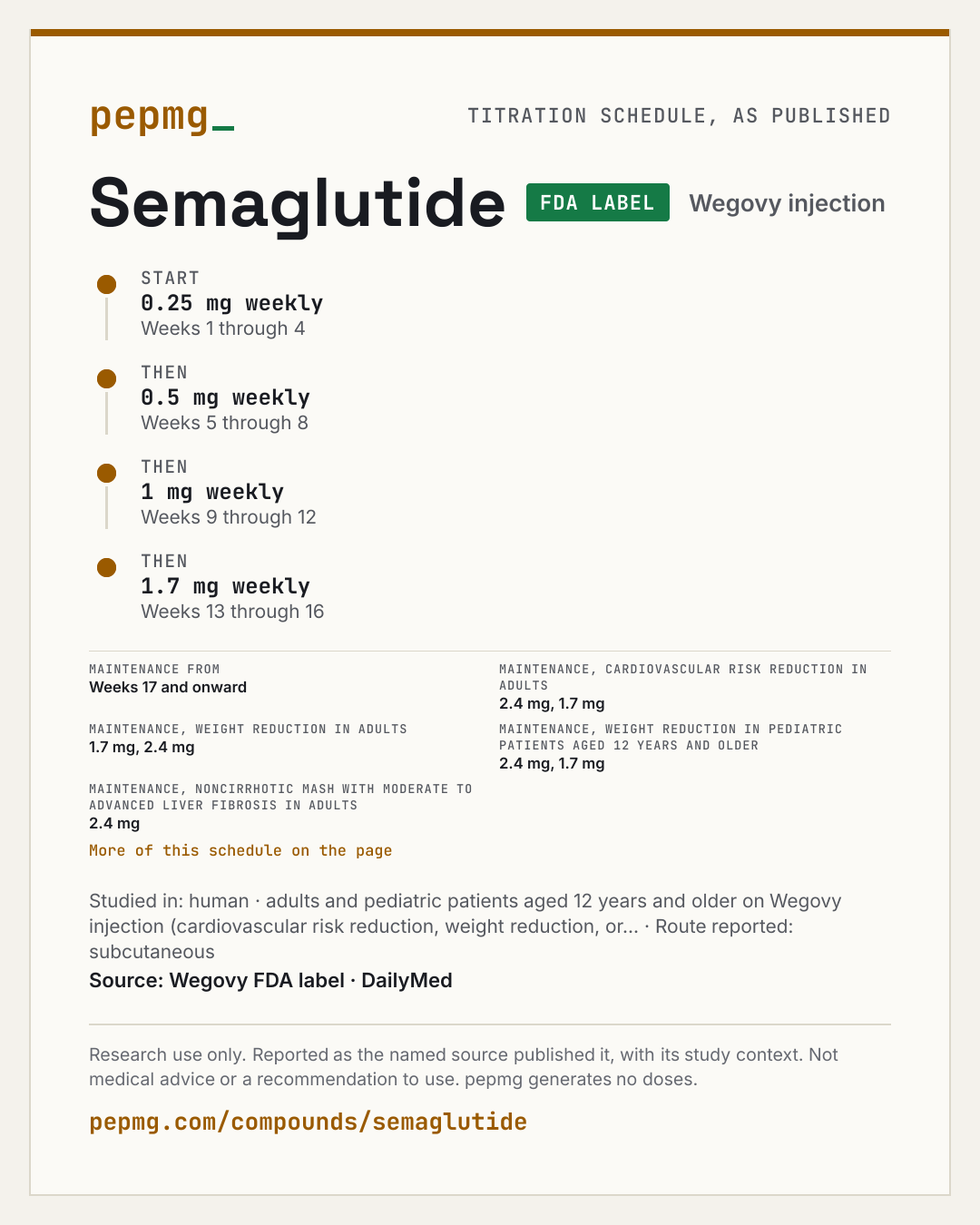
Maintenance from
Weeks 17 and onward
Maintenance, cardiovascular risk reduction in adults
2.4 mg, 1.7 mg
Maintenance, weight reduction in adults
1.7 mg, 2.4 mg
Maintenance, weight reduction in pediatric patients aged 12 years and older
2.4 mg, 1.7 mg
Maintenance, noncirrhotic MASH with moderate to advanced liver fibrosis in adults
2.4 mg
Maximum, weight reduction in adults
7.2 mg
Note
If patients do not tolerate a dose during dosage escalation, consider delaying dosage escalation for 4 weeks.
Wegovy injection. Titration schedule exactly as Wegovy FDA label · DailyMed ↗ published it, step for step. pepmg does not compose or adjust schedules.
Save the card: landscape · portrait
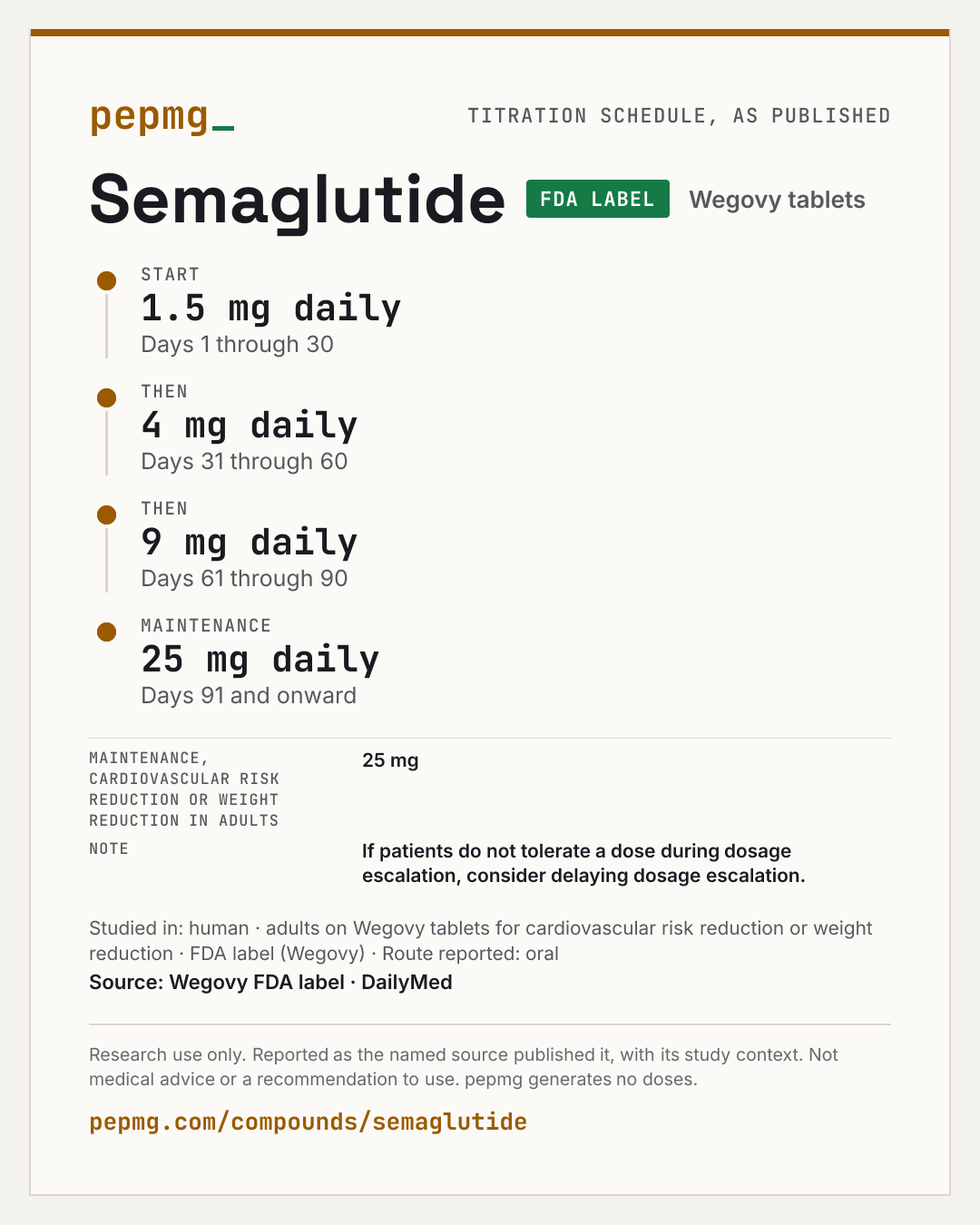
Maintenance, cardiovascular risk reduction or weight reduction in adults
25 mg
Note
If patients do not tolerate a dose during dosage escalation, consider delaying dosage escalation.
Wegovy tablets. Titration schedule exactly as Wegovy FDA label · DailyMed ↗ published it, step for step. pepmg does not compose or adjust schedules.
Save the card: landscape · portrait
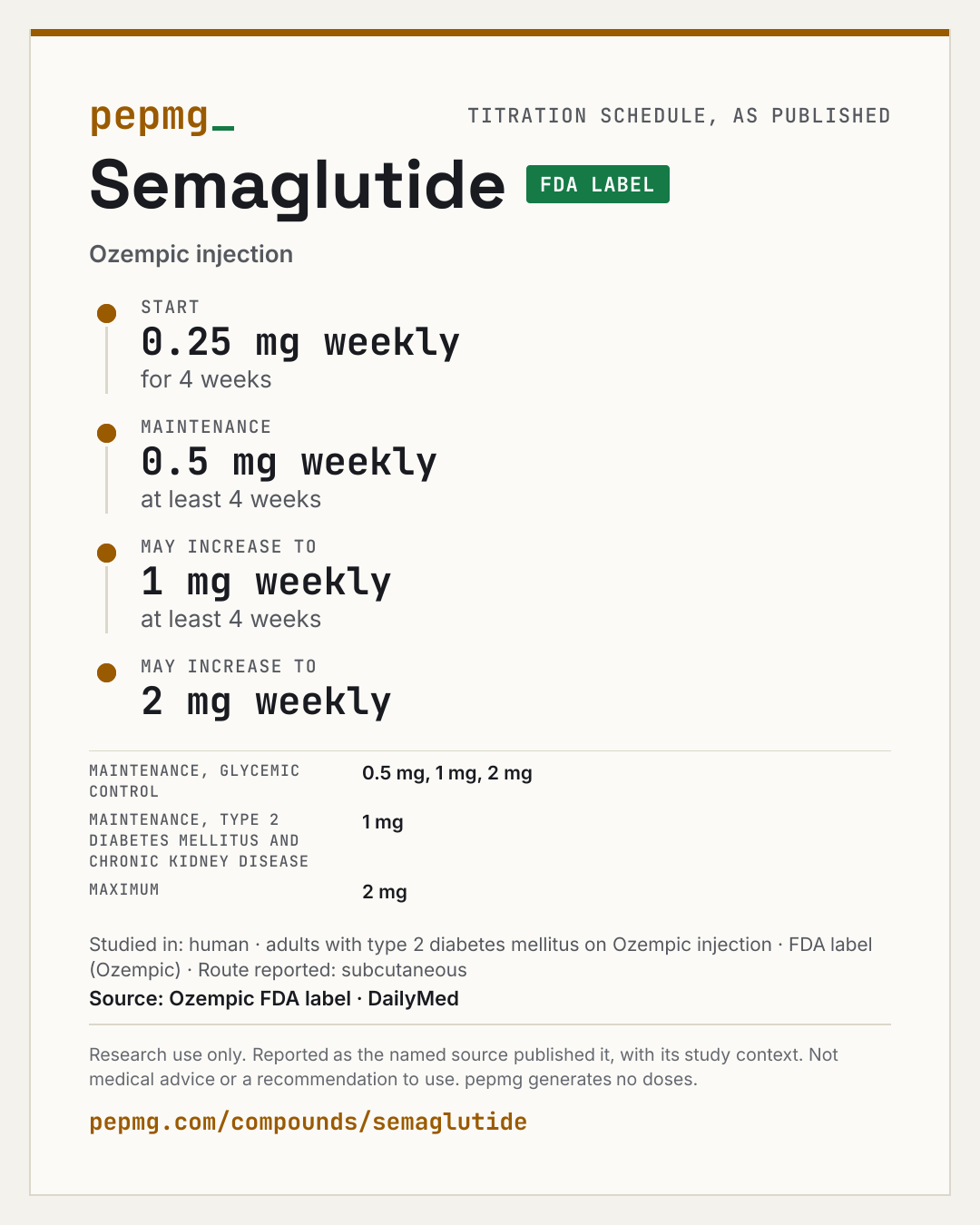
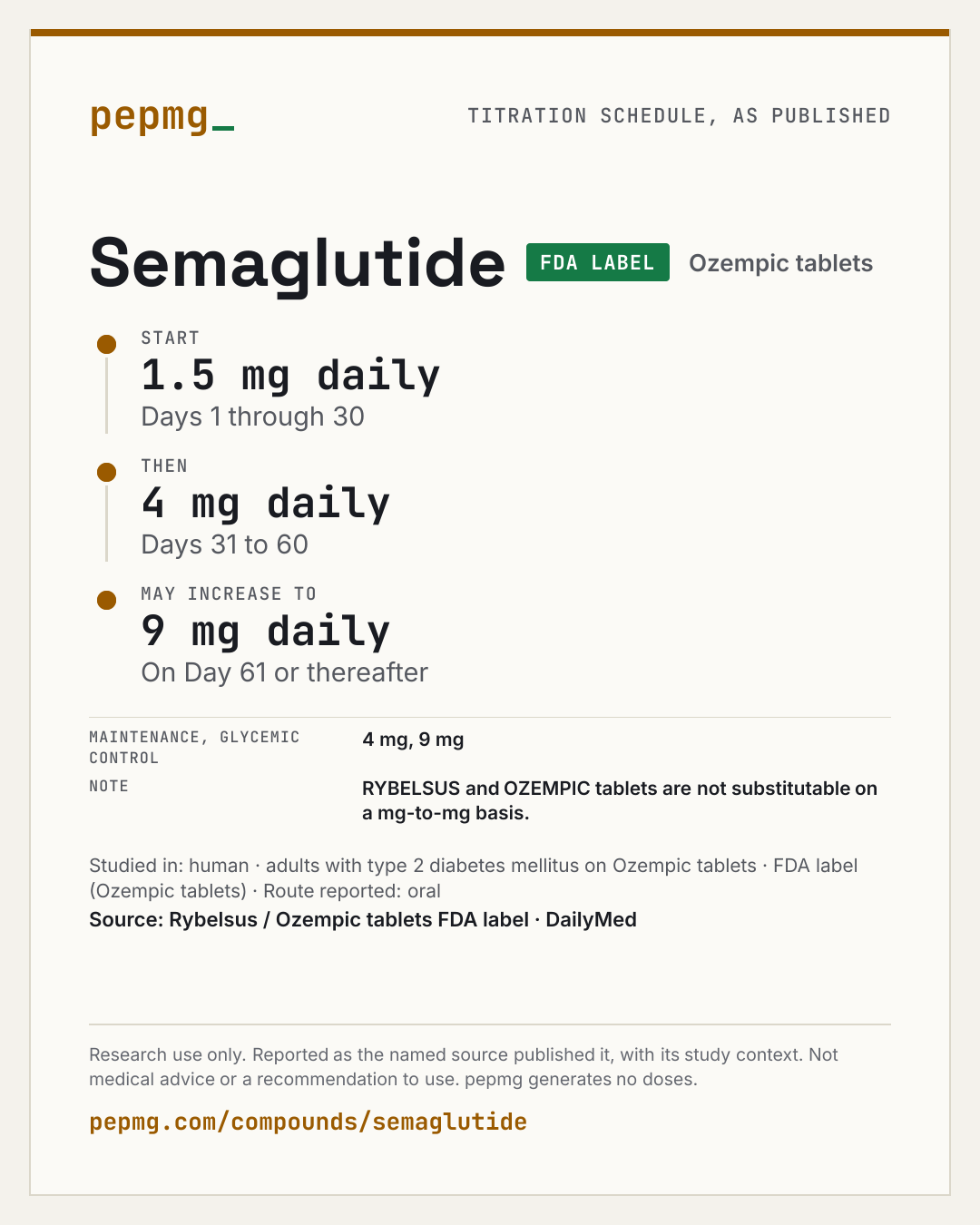
Maintenance, glycemic control
0.5 mg, 1 mg, 2 mg
Maintenance, type 2 diabetes mellitus and chronic kidney disease
1 mg
Maximum
2 mg
Ozempic injection. Titration schedule exactly as Ozempic FDA label · DailyMed ↗ published it, step for step. pepmg does not compose or adjust schedules.
Save the card: landscape · portrait
human · weight reduction in adults with obesity, or overweight with a weight-related condition (2.4 mg is the label's recommended maintenance dose) · FDA label (Wegovy injection) · Route reported: subcutaneous
human · weight reduction in adults who tolerate 2.4 mg for at least 4 weeks and need additional weight reduction (the label's maximum) · FDA label (Wegovy injection) · Route reported: subcutaneous
Research use only — this reports what an FDA label, a peer-reviewed study or a clinical-trial registry entry published, tied to its species and study context. A trial-registry figure is what a sponsor registered, not a peer-reviewed result. It is not medical advice, not a recommendation to use, and no dose here is generated by pepmg. Any dosing decision is for a qualified professional. Animal-study amounts do not establish a human dose.
This trial assessed the efficacy and safety of the GLP-1 analogue once a week subcutaneous semaglutide 2.4 mg versus semaglutide 1.0 mg (the dose approved for diabetes treatment) and placebo for weight management in adults with overweight…
Meta-analysishuman Journal of the ASEAN Federation of Endocrine Societies · 2022 · PMID 36578889
The weight loss benefit of semaglutide in patients with diabetes is well-documented, but its clinical utility in treating obesity among patients without diabetes is less described. We therefore assessed the efficacy and safety of…
Reviewhuman Frontiers in endocrinology · 2021 · PMID 34305810
The glucagon-like peptide-1 receptor agonist (GLP-1RA) semaglutide is the most recently approved agent of this drug class, and the only GLP-1RA currently available as both subcutaneous and oral formulation. While GLP-1RAs effectively…
A few representative studies, each summarized on this site with the PubMed record linked beside it — not an endorsement or a claim that any result applies to human use. Read them and judge for yourself. Everything here is research use only.
Per-mg prices for semaglutide vary significantly across vendors due to differences in synthesis purity, scale, and sourcing of raw materials. Comparing prices helps researchers identify cost-effective suppliers while maintaining quality standards for reproducible experimental results.
▸ Reading the COA
A third-party Certificate of Analysis (COA) for semaglutide should confirm identity via mass spectrometry (e.g., ESI-MS) and purity ≥98% by HPLC. Common issues include under-filling (e.g., actual content below labeled mg/vial) and adulteration with truncated or oxidized peptide fragments.
▸ FAQ
How should I store semaglutide for research use?
Lyophilized semaglutide should be stored at -20°C or below, protected from light and moisture. Reconstituted solutions are typically stable for short periods at 2-8°C, but researchers should verify stability data from the supplier.
What is a Certificate of Analysis (COA) and why is it important?
A COA is a document from the supplier or third-party lab detailing the compound’s identity, purity, and batch-specific test results. It is critical for verifying that the peptide meets research-grade specifications and is free from contaminants.
Why do prices for semaglutide differ so much between vendors?
Price differences arise from factors like synthesis scale, purification methods (e.g., HPLC vs. flash chromatography), and vendor overhead. Lower prices may indicate lower purity or under-filling, so researchers should always check COAs before purchase.
All products listed are sold by third-party vendors for laboratory and research use only (RUO). Where an FDA label, a peer-reviewed study or a clinical-trial registry entry has published a dose, pepmg reports it with the source named and the tier labeled (a registry figure is marked trial registry, not peer-reviewed), because that is safer than guessing. It is a report, not medical advice and not a recommendation to use anything. pepmg sells nothing and ships nothing. Listings are price-tracking data, not endorsements.
✓
+ Get the free Weekly Price Index One email a week — where every compound's $/mg moved. No spam.