The COACertificate of Analysis: a lab report stating a batch's measured identity and purity. , honestly
A Certificate of Analysis is the single most useful document a peptide vendor can publish — and one of the easiest to misunderstand. Here's what it actually tells you, what it can't, and exactly how pepmg treats it.
▸ What a COA is
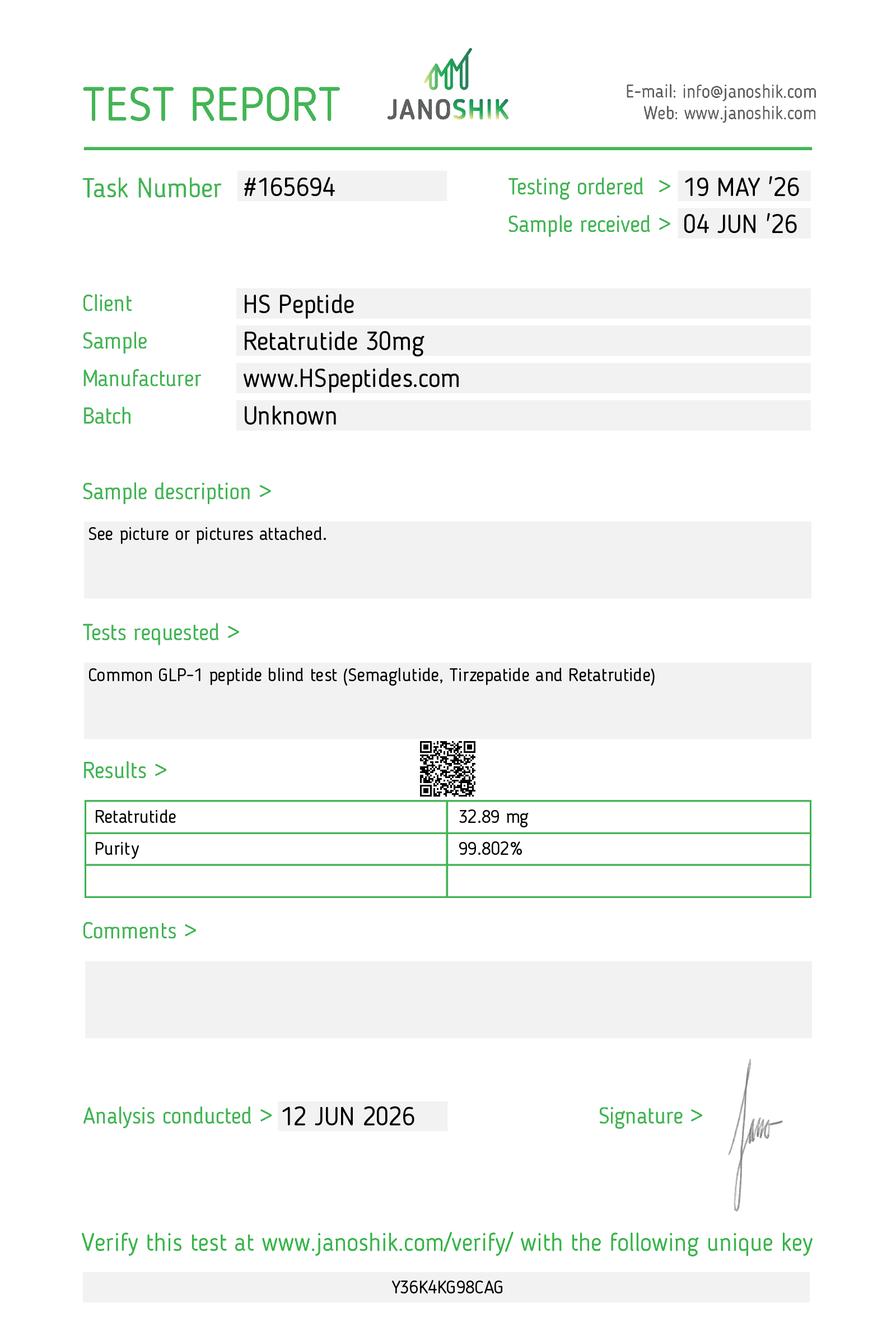
A COA is a lab's report on a specific batch of material. For research peptides it usually reports two things:
- Identity — is this molecule actually the peptide on the label? Confirmed by mass spectrometryA lab method that measures the mass of a sample's molecules to help confirm a compound's identity. (the measured mass matches the peptide's theoretical mass).
- PurityThe share of a sample that is the intended compound, usually reported as a percentage on a COA. — what fraction of the sample is the intended peptide vs. truncated chains, byproducts, or residual solvents? Measured by HPLCHigh-Performance Liquid Chromatography — a lab method that separates a sample's parts to measure how much of each is present. and reported as a percentage (research-grade is typically ≥98%).
Some COAs add mass/quantity (does the vial contain the labeled milligrams?) and tests for specific contaminants. That's the useful core: identity, purity, quantity.
▸ Purity vs. net content — what you actually pay $/mg for
Two numbers on a COA get confused, and the gap between them is money. PurityThe share of a sample that is the intended compound, usually reported as a percentage on a COA. is the fraction of the peptide present that's the right molecule. Net peptide contentThe actual mass of peptide in a vial, after subtracting non-peptide material like salts and water. is how much of the vial's labeled mass is peptide at all — the rest is counter-ion salt (acetate or TFA) and residual water left from lyophilizationFreeze-dried — dried by freezing and removing the ice under vacuum, leaving a stable powder. .
A batch can be 99% pure and still run ~80% net peptide, so a labeled 10 mg vial holds closer to 8 mg of actual peptide. Because our tables rank on the vendor's labeled milligrams, low net content quietly makes the real $/mgPrice divided by the milligrams of active compound — the like-for-like way to compare cost across different vial sizes. higher than the sticker — two "same-size, same-price" vials aren't always the same buy. Net content is rarely published (it needs amino-acid or nitrogen analysis), so when a COA reports it, that's a real transparency signal and the most honest basis for $/mg there is.
▸ What a COA does not prove
- Not your vial. A COA covers the batch that was tested. The vial you receive is only as represented as the vendor's batching and honesty make it.
- Not safety, and not fitness for any use in humans. Purity is not approval. These are laboratory reference materials.
- Not un-fakeable. A PDF can be edited; a template can be reused. This is the important one, and it's why we do not claim to detect "fake" or "AI-generated" COAs — no honest tool can. Instead we look at something checkable: who is standing behind the document.
▸ The one thing that raises a COA above "trust me"
A COA is only as credible as the party that can confirm it. That's why where the results live matters more than how official the PDF looks:
- Lab-hosted — the results are viewable on the testing lab's own site (e.g. Janoshik), where the lab itself stands behind them. This is the strongest public signal a buyer can get without commissioning their own test.
- Self-hosted, lab named — a real third-partyAnalysis done by an independent lab, not the seller — so the result doesn't come from the party making the sale. lab is named, but the documents live on the vendor's own site. Plausibly genuine; not something the lab confirms for you.
- Unattributed — COA-style documents with no testing lab named. Weakest published tier.
- Account required — the vendor has a COA page, but it sits behind a sign-in, so we cannot read it from outside and neither can you before you register. Not a third-party pass, but emphatically not an absence either.
- Lab named, no document reachable — the vendor names a real testing lab, but we could not open a certificate anywhere public. The claim is visible; the evidence is not.
- None — no COA presence found.
These are exactly the tiers pepmg detects automatically and folds into each vendor's transparency score. Ranking is still $/mg only — a COA can lift a vendor's trust score and badges, never its price rank.
The bottom two tiers exist because of a mistake we made. A vendor told us their rating was wrong, and they were right: their COA page required an account, our crawler saw the sign-in screen, and we recorded it as though they published nothing — while 48 real certificates sat public on the same site. Not being able to see something is not the same as it not existing, and a vendor should never be marked absent because of a gap in our tooling. These tiers say what we actually observed instead.
▸ Reading one yourself — a 30-second checklist
- Does the peptide name and sequence on the COA match what you're buying?
- Is there a mass-spec result, and does the measured mass match the peptide's expected mass?
- Is HPLC purity stated as a number (not just "passed"), and is it ≥98%?
- Is there a batch/lot number and a date — and does the lot tie to the product you're ordering?
- Is a testing lab named, ideally one whose results you can look up independently?
▸ pepmg's stance, in one paragraph
We link what vendors publish and we classify how verifiable it is. The question that decides a vendor's standing is can you open this certificate at the testing lab — not where the vendor chose to put the file. A result you can check at the lab outranks one you cannot, and below that a named lab with readable documents outranks an unattributed document, which outranks one behind an account, which outranks a lab merely named with nothing to open. We do not run the labs, we do not test the material, and we do not certify purity or authenticity — anyone who tells you they can verify a peptide's purity from a web page is selling something. What we can do is make the published evidence easy to find, honestly labeled, and impossible to buy your way up the ranking with. The rest — vetting a source before you buy — is genuinely yours to do, and we've tried to make that call as informed as we honestly can.
We count every certificate, not the best one. That ladder describes a single document. A vendor usually publishes dozens, and they are rarely all the same: one vendor had 33 certificates you could open at the testing lab and 147 more that opened as an image on their own server, and for a while we rated them on the 33. So a vendor's standing now reflects the whole set, and we publish both numbers, as in "180 COA documents found, 33 of them openable at the testing lab's own site." A certificate we could not read, could not reach, or never found counts against nobody, because that is our gap and not the vendor's. Only documents we confirmed at a lab move the number, and they only ever move it up.
How we collect & rank prices → · Back to the index →